

 Posted by
In addition to my Pinterest fail blue wave blueberry thumbprint cookies (hey, they tasted really good), Democrats failed in creating a full-on blue tsunami by only gaining control of the House.
Sure, by the looks of things, we lost. We don’t have the fancy 6-year Senate seats … but what we do have are the impassioned 2-year seats of state representatives. Senators have plenty of time to become embroiled in politics, cozy up with lobbyists, and lead a life detached from the citizens they represent. In the end, they wind up fighting for their own best interests and have to kiss ass for like, a year, before election time.
Representatives, however, have to act quickly to make changes and they need a lot more accountability. They are usually an actual part of the communities, or small districts, that they represent. They have a hell of a lot more at stake in terms of pleasing the people if they want to be re-elected, and not a ton of time to get things done.
I thought this would be a good time to do a little refresher on the separation of powers and checks and balances. Even people who are into politics may not know exactly how the branches of the government were created to ensure tyranny wasn’t an option (and how those articles written by our forefathers are being abused, but from one post, many).
It’s nothing to be ashamed of. It’s complicated and a little boring, so I’m just going to give you the highlights. In this post, we will look at the Legislative branch specifically as it is currently most relevant.
The first three articles of the constitution outline the separation of powers, or the three separate branches of government: the legislative (congress), the executive (the president), and the judicial (the supreme and federal courts).
“The accumulation of all powers, legislative, executive, and judiciary, in the same hands, whether of one, a few, or many, and whether hereditary, self-appointed, or elective, may justly be pronounced the very definition of tyranny.” – James Madison, Federalist 47, 1788
After fleeing Great Britain, our founding fathers were kinda triggered by the possibility of tyranny emerging from the government they constructed. This is exactly why it was created in the way it was, from checks and balances, to the fluidity of the constitution (which, by the way, is written into the articles of the constitution as a check itself on the branches of government, however it is checked itself with the allowance of amendments).
These are the main differences between what the House does and what Senate does. Then we will talk about how its not working for us today.

What Article I Looks Like IRL
The three separate branches alone certainly weren’t enough to prevent tyranny. One could argue we were pretty damn close with Trump’s Republican majority in all three branches, precisely what Madison warns us about above. It’s funny because there is one thing I won’t ever forget from my childhood is at some point, probably during the Bush Sr. or the Clinton era.
I was watching TV with my father, a lifelong Republican until George Bush Sr., and something caused him to shake his head and say, “One thing you need to know is that there should never be a monopoly of any party in all the branches.” I remember asking why, it was his party with all the power, and he shot back with the old dadism, “Absolute power corrupts absolutely.”
But he’s right. And I never fully understood how profound what he said was until it actually happened. It’s even more horrifying when it’s not your party. The Kavanaugh “investigation” was one of the biggest embarassments in FBI history. Why? Obviously, because they appointed someone to the supreme court who shouted “I LIKE BEER” during a congressional hearing, but the behavior of some of the senators who seem to invoke the spirit of Trump were far more disturbing than the actions of a rogue frat boy.
The partisan nonsense that occured during that hearing was exactly what the founding fathers feared most – a group in power that can say whatever it wants, unchecked. An investigation shot twice in both legs and sent running cross-country in a week. The blatant misstatement of facts under oath that passed under the radar, and so on.
Those are the things the founding fathers did not want. They wrote the constitution with a certain leeriness toward power, and rightfully so. They would not want one party to rule all, and they certainly would not want said party to manipulate people by lying and perpetuating conspiracy theories.
I’m sure these founding fathers would’ve wondered the same thing we did: There were plenty of other right-wing potential nominees, why insist upon this one so intently? Is it just to win, or is it more insidious? One would have to be naive not to believe that the President was using the branches of government to his advantage while he is under active FBI investigation and has a rather checkered past. It is not as though he hasn’t been deceptive before.
So, when you see people saying that the founding fathers are rolling around in their graves, they aren’t wrong. That’s why I’m doing this three part series on the branches of government and how the writers of the constitution intended them to be checked by one another. A beautiful system now entirely corrupted.
Article I as Intended

Article I sets the groundwork for the legislative branch, the most powerful in our government. Such is it’s strength that there is a check within this check. Inception. And that is the creation of a a bicameral, or two house, government. Congress was divided into the Senate and the House of Representatives.
The founding fathers had some trust issues, and some didn’t believe in super direct government (hence the electoral college). Senators were chosen by State governments until the 19th century. But the big tussle was over representation by population versus equal representation.
States with more people obviously wanted population-based representation. States with small populations wanted equal representation, period. So, despite it being a room full of men, they managed to compromise. The Connecticut Compromise allowed for both types of representation with equal in the Senate and by population in the House.
In the Senate, each state has two representatives. In the House, the limit of representatives is 435, and each state must have at least one representative. Those with larger populations have their number of representatives determined by its proportion to other states and how those all work into the set number of 435. So, some states, like Vermont, have one representative, and others, like California have 53.
It’s important to emphasize again the difference in connection to their support base. Senate has only two representatives per state. Most states have more in the House, and the districts are relatively small in most cases, which naturally leads representatives in the House to relate and find common ground with their base a big more.
But the most glaring difference between the two houses of Congress has a weird twinge of classism. The fact is, it costs a great deal of money to sit in either house of the legislative branch and I don’t really feel like getting into the whole campaign funding debate right now. But both the cost and general life experience are the issues when it comes to classism in this matter. Obviously racial diversity is an issue too, but it warrants a separate post.
At face value, the average seat in the House will run you about $1.4 million. But for a seat in the Senate, you’re looking at a cool $8.5 million. The numbers do vary pretty widely, but the point is it is expensive, and Senate is nearly eight times as expensive, the terms are three times as long so you have less of that accountability that we spoke about and you probably have a very different lifestyle than many of your constituents.
After researching this, I saw some YouTube videos that made the House of Representatives seem like something out of a Town Hall meeting on Parks and Recreation, with fist fights and yelling, while Senate has the far more civilized filibuster. But I’m still relatively young.
Article I IRL
The outlandish behavior of both Kavanaugh and the Republicans (tell me the Democrats were unhinged and I WILL lose it; I will die on this hill) actually shocked me.
It brought me back to being young and stupid and in a verbally abusive relationship. Just listening to it made me feel small and scared, jumpy. I kept flinching, waiting for the next outraged old white man to start waxing philosophic while sharing such complete misinformation about testimony that had just been given that morning. Praying that they’ll just stop.
When someone tells you who they are, listen to them. We saw who those senators really were those day and in the days that followed. These old men were rude and disconnected, plain and simple. The grinchy guy in charge, Grassley, was more concerned about getting back to the home in time for the early bird special. Lindsey Graham roared in anger and defense of Kavanaugh’s despicable behavior.
The way they attacked this woman was the way mean girls that wear pink on wednesdays do in the school cafeteria. Brett acted like the “lovable” beer-guzzling frat boy who “didn’t need” to assault someone for sex. Come on, he was so cool! He had calendars! The mean girls, spearheaded by Lindsey, blessed us with a rainbow of personalities, from pathetic, vaguely creepy and weepy Ted Cruz, to grouchy white rabbit with his pocketwatch Grassley, to Blanche DuBois impressionist Lindsey Graham, and fake martyr, real attention whore, Jeff Flake.
Among many other things, I realized that the Senate was completely out of touch. Yes, there are women, a handful of POC, etc., but the majority is painfully obvious.
Something tells me that had this gone before the House, the outcome may have been different. Perhaps more passionate on both sides, but more genuine.
You know how everyone says, “Oh, I don’t like xyz, he/she is a career politician?” Well, that hearing showed me exactly what being a 6-year term, eldery career politician looked like.
One thing that I struggled with consistently during the Republican’s questioning of Dr. Ford was the way they repeated her account. They just weren’t listening. They heard what they wanted to.
So broad and complex was their distance from the victim experience that their minds scrambled for minutia while ignoring multiple elephants in the room. I had always known senators were disconnected, but that hearing had it on full blast, live and in stereo.
Where am I going with this long diatribe? Hopefully, its an example to help you grasp my next point.
The least of our worries about the Senate involves the cost of their campaigns, or their career experience specifically. It’s this lack of diverse experience combine
d with living a sheltered, “high class” lifestyle.
That is not to say that one cannot graduate from the House to the Senate. Many senators were once representatives. But that probably feels like another life.
My theory is that those in the House have very diverse life experiences, and when such a group comes together, they can use their collective journies to better empathize with others and calculate the impact of their decisions and actions.
According to the Congressional Research Service 2018 report, the 100 Senate members had one of four careers: lawyer, public servant/politician, education, or business. Aside from perhaps education, which accounts for 20 members of the senate, these are white collar jobs and some have natural paths into politics.
The House, however, does have about the same proportion of these four professions, however it’s in those unaccounted for gaps that diversity happens.
Instead of just the lawyers, politicians, educators, and business people that make up the 100 members of Senate, the 435 members of the House are a far more accurate reflection of the American people based solely upon the variety in their education and professions.
For example, 50 senators are lawyers, which means they hold law degrees. 44 were also politicians, 20 were in education, and 29 in business. Here is a chart comparing that to the House:
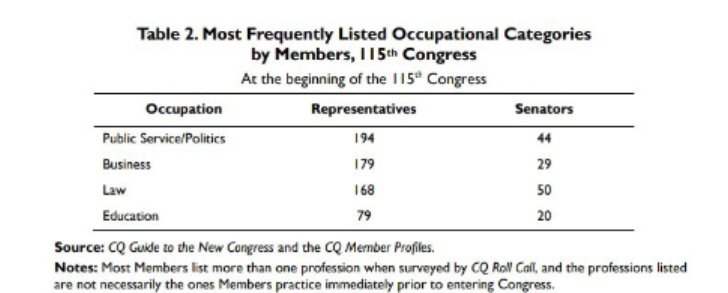
But the House has everything from farmers to venture capitalists, insurance agents to military reserves, radio and TV personalities to engineers, former FBI agents to former CIA agents. And more according to the same Congressional Research Science report.
Basically, the House is more, well, representative of the population. Which sounds great on paper, but the reality is that the “grown-ups” in Senate have to approve any Bill the House passes, any official they impeach, and so on and so forth.
When this system works, it works. But in reality, we have become so divided as a nation that there is little help anything can be resolved, even with the Democrats in the House.
Bills will be passed back and forth between the House and Senate, with the House ultimately conceding to the wishes of Senate and the Bill, once law, is nothing but a shadow of its former self.
So yes, our founding fathers did attempt to give us checks and balances, however they do not account for when there is a monopoly, and not a charm school or scrap of accountability in sight.
But, similar to how the electoral college elects the president for us, the House gives the normal population some semblance of power, but their voice is only heard when Senate approves every single syllable. Sure, the House has the sole right to write revenue based bills, and impeach officials, but all of that is just smoke and mirrors when the Senate has to approve everything. It’s just more ping pong until the next election.
My point is, if the Senate was more “down-to-earth” and diverse in their life experiences, the government would actually be representative of the people and not a bunch of old, bloated, angry white men.
The House and Senate also have the most power in terms of checking other branches, but we will talk more about those when we get to the Executive and Judicial branches in separate posts.
Each Thursday will be Throwback Thursday here and we will look at something created back in the day and see where it is now. Kind of like those “I used to be a nottie, and now I’m a hottie” episodes of Jenny Jones (or maybe vice versa in some instances…)
 The Snowflake Mafia